vol I chap 1 sect 2
Previous: 1.1 . Mathematics and science in ancient Greece.
1.2. Conceptualizations of spaces and quantum statistics.
The first part of this section is based on the conference Géométrie et astronomie sphérique dans la première cosmologie grecque by Jean-Pierre Vernant (1963). All the considered conceptualizations of space as democratic or dictatorial were accomplished before the Christian era. The second part refers to a building process in quantum statistics where particles are classified in families according to criteria that can be referred as democratic or dictatorial.
Circular spaces in political organizations and astronomical and geometrical spaces.
Before political institutions were established in Greece, the highest level in the social organization was occupied by the king-priest. The entire population was always under conditions of domination and submission. There were no spaces for communications. Public affairs were not discussed, they were imposed. However, laws and rules were promulgated and made public in written.
Vernant considered how the evolution of ancient Greek society generated two kinds of conceptual developments in social contexts related to the conceptuaization of space:
(1) the building of circular spaces in family life and community (the reference is made to the philosopher Pherecydes, the historian and geographer Herodotus, the poet Homer, and the architect Hippodamus), and
(2) the concept of circularity in the definition of astronomical spaces (reference is made to the poet and philosopher Hesiod and to the philosopher, geographer and physicist Anaximander).
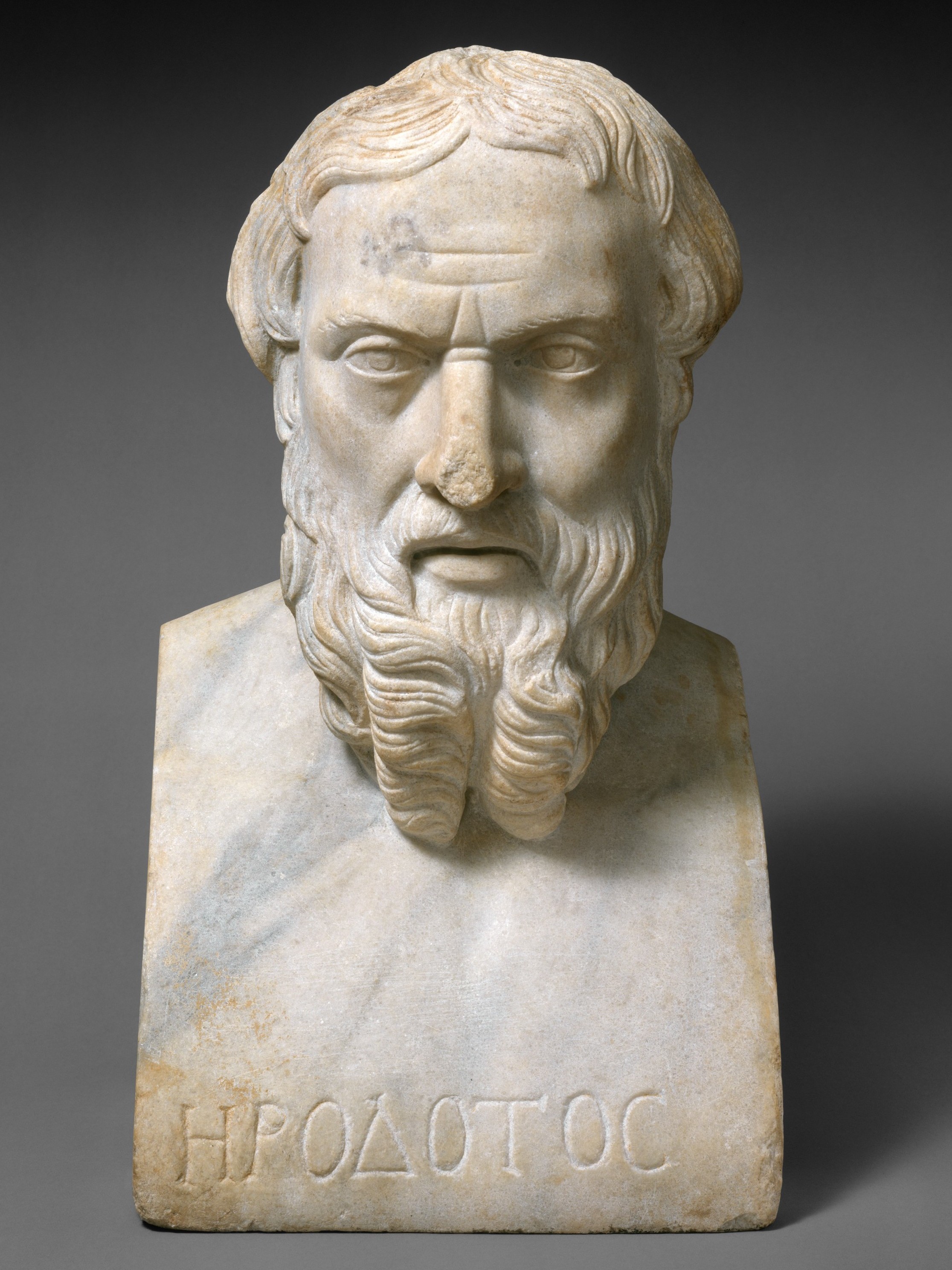
When Greek cities were built (the polis) writing was used as a transforming instrument that made public private issues. Probably it was Pherecydes of Syros (580 BC – 520 BC) the first writer to publish a philosophical work in prose. He wrote books for transforming private knowledges into public possibilities for discussion. Herodotus of Halicarnassus (484 BC- 425 BC) mentioned that when the dictator Polycrates of Samos died, his successor asked all the citizens to meet in an assembly and informed them that he will behave in a democratic way in total disagreement with his predecessor

|
|
|---|
Homer (VIII century) wrote in Odyssey (chant II) that Telemachus, son of Ulysses and Penelope, was worried because many pretenders to the throne were harassing his mother. He asked soldiers to protect her by forming an agora (Greek word for an assembly). It is attributed to the same writer the use of the word ageirien laon, that means to congregate the army.
One of the first urban architects Hippodamus of Miletus (498 BC- 408 BC) rebuild Miletus around 479 BC. The city was sacked and destroyed by Persians in 490 BC. The map made by Hippodamus shows an ordered reticular structure having an agora as its center with broader and straight streets.

|

|
|---|
According to Vernant, the new image of the democratic Greek society went in parallel with a new image of the astronomical and geometrical spaces. This conceptual change implied overcoming astronomical Babylonian ideas as well as eliminating myths about the form of the Earth.
Astronomy in Babylon characterized a religion believing that stars were divinities whose intentions might be perceived if their positions in the sky were carefully observed and registered. Scribes serving the king were in charge for registering the economic activity of the kingdom and for accounting all celestial and terrestrial events. Their knowledge was arithmetic without connections to any geometrical system of spatial representations of positions and movements. However, Greek ancient astronomy was looking for explanations about the structure of the world without appeal to divinities nor ritual ceremonies, although it was full of myths.
Hesiod of Askra; Thebes (nearby 800 BC) wrote a Theogony, a mythological treatise describing the origin of gods. According to him the Earth was a vessel whose interior contained a structured world enclosed by Zeus to avoid the perception of light in the disordered world: at the upper level lived Zeus and immortal gods, then the human beings and downward death and underground gods.
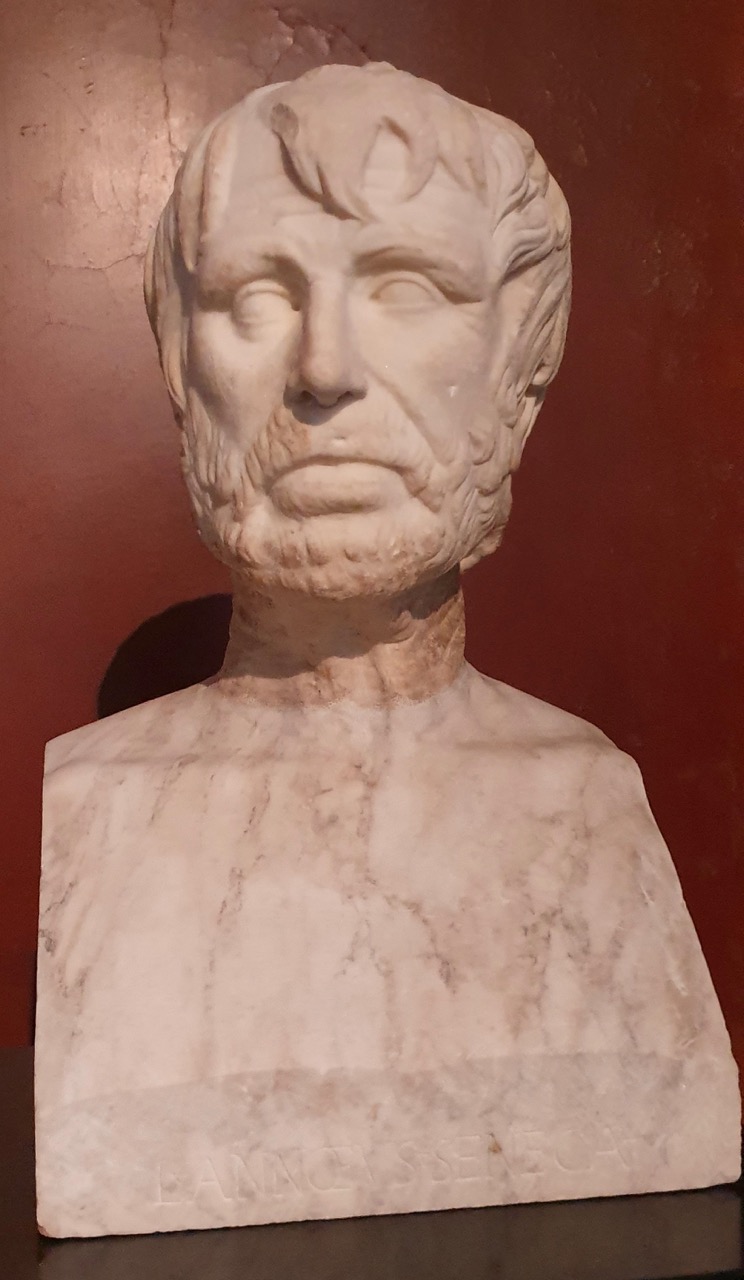
Anaximander of Miletus, Ionia, (619 – 546) had a spherical notion of the universe whose center contained the Earth as a cylindrical column at equilibrium, stagnant and without falling. This was a democratic conceptualization of space were all positions and distances were mathematically defined.
|

|
|---|
The agora.
As a part of a demystification and rationalization process of the social life, the agora was a center for political actions and decisions with social, urban and cultural implications for the community. In that place democracy and law application were expressions of equality, equilibrium, symmetry and reciprocity. This was an indication of the appearance of new politically centralized institutions.
Just for comparison, it is interesting to observe the presence of meeting regions in the following archeological sites:
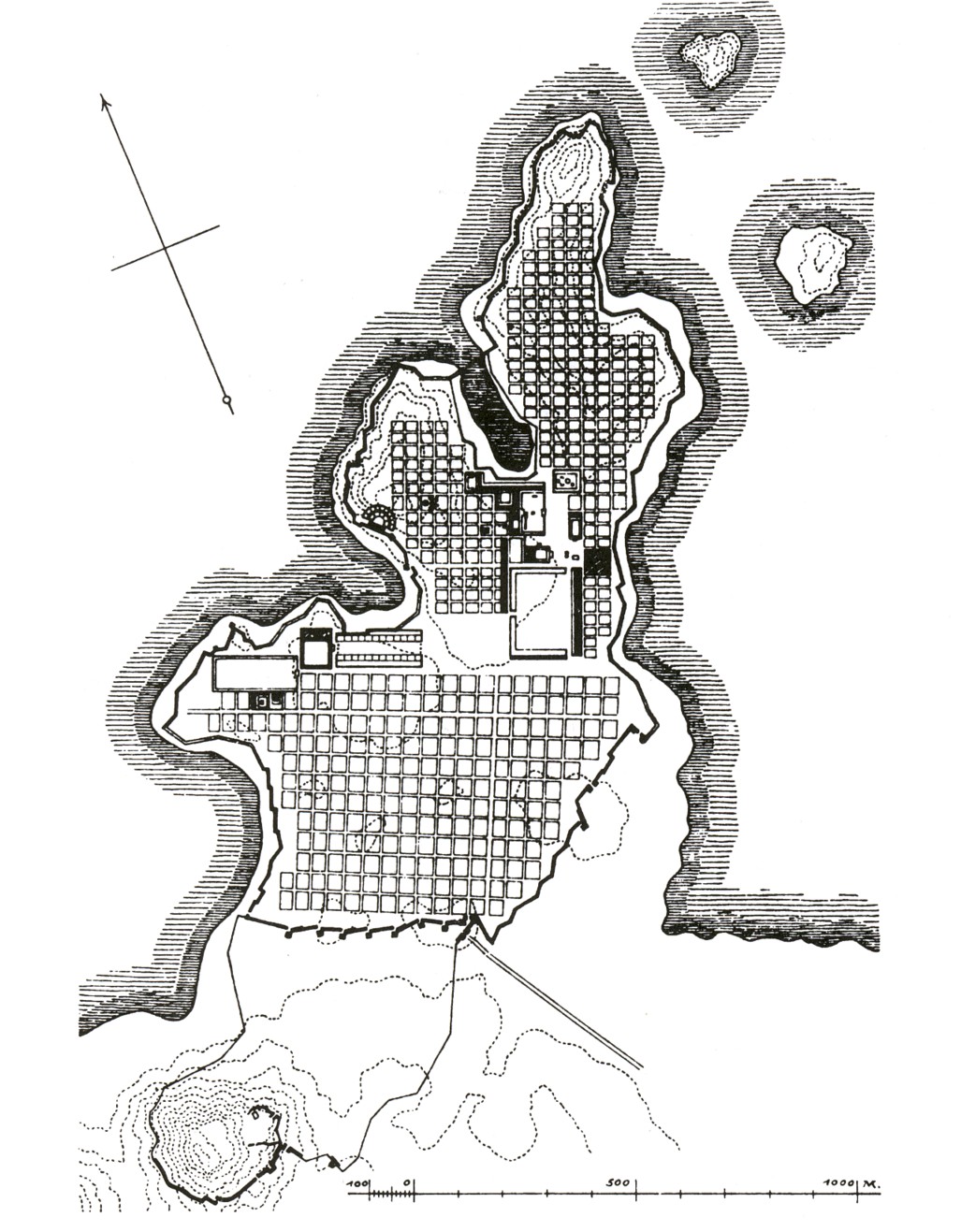 [Plan of Milet in the Classical period](https://en.wikipedia.org/wiki/File:Miletos_stadsplan_400.jpg inside https://en.wikipedia.org/wiki/Miletus), nearby 490 BC.
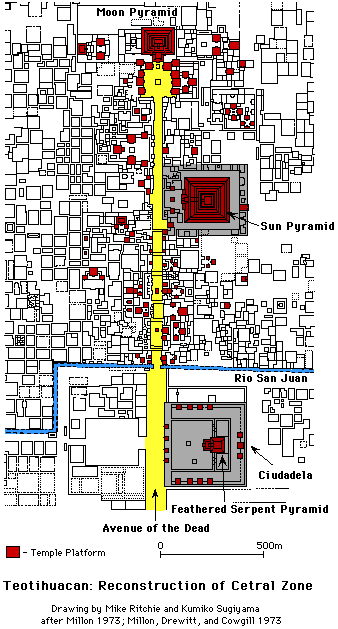 [Sun pyramid in Teotihuacan](https://upload.wikimedia.org/wikipedia/commons/1/14/Teotihucan_layout.gif inside https://en.wikipedia.org/wiki/Teotihuacan), Mexico, nearby 450 AC.
 [Residential palace in Machu Pichu](https://en.wikipedia.org/wiki/File:Karta_MachuPicchu.PNG inside https://en.wikipedia.org/wiki/Machu_Picchu), Peru, nearby 1500 AC.
 [Massada](https://en.wikipedia.org/wiki/File:Map_of_Masada.svg inside https://en.wikipedia.org/wiki/Masada) in Israel, nearby 20 BC

